
 Home
 Hydraulic dynamometer

Water brake testing / heavy-duty applications
A water brake dynamometer for diesel engines is worth evaluating when the test requires substantial shaft-power absorption, defined high-torque operating points and sustained loaded operation. Its suitability depends on the selected machine's torque-speed envelope, minimum load, control behavior and the facility's ability to remove heat throughout the test.
That makes water brakes relevant to heavy-duty engine programs, but not automatically suitable for every diesel test. Motoring, demanding dynamic simulation, very low load or an inadequate cooling plant can change the selection. This guide explains the application questions to resolve before choosing a hydraulic engine dynamometer.
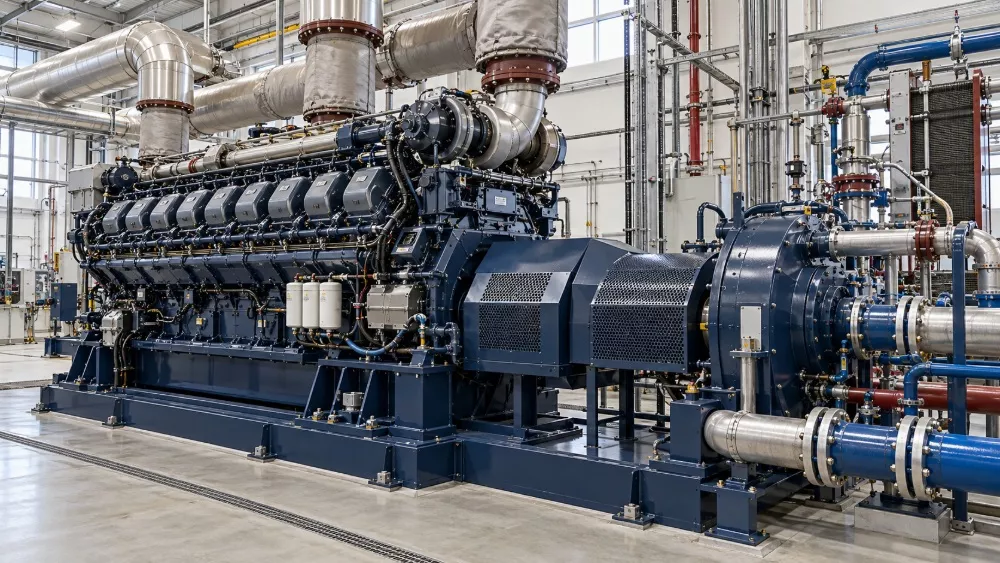
01 / ENGINE TESTING GUIDEHigh-power diesel test requirements
Start with the operating task
An engine-rebuild team may need to verify a repaired engine against its approved acceptance schedule. A development laboratory may need loaded measurements across several speeds. An endurance program may need long operation at specified conditions. All can involve the same engine family while demanding different evidence and system duties.
Power Test's types-of-dynamometers overview identifies high-torque engine applications in mining, power generation and marine propulsion. That supports the application category, not a conclusion that every engine in those sectors fits any particular absorber.
Define the required shaft-output points, duration and engine configuration. Include accessories, fuel, cooling conditions and the intake and exhaust arrangement. A peak rating taken from a brochure does not describe the complete test that the engine must complete.
Separate engine testing from installed-system testing
An isolated engine test can assess shaft performance under the documented bench conditions. It does not automatically verify the complete vehicle, vessel propulsion train or generator set. Those assemblies introduce their own measurement boundaries and operating requirements.
For the shaft boundary, see what an engine dynamometer measures. If the question concerns a complete installed vehicle, the engine dyno vs chassis dyno comparison helps distinguish the required evidence.
Specify acceptance before testing. A loaded run can produce useful information without satisfying every point of a particular engine program. The report should identify what was tested and what remains outside its scope.
Turn application labels into requirements
| Test purpose | Main requirement to define | Evidence to retain |
|---|---|---|
| Post-repair verification | Approved points and engine configuration | Actual output, conditions and acceptance disposition |
| Development evaluation | Required speed-load region and supporting channels | Comparable data with configuration and timing records |
| Endurance operation | Duration, sequence and sustained facility duty | Accepted intervals, thermal conditions and events |
| Multi-engine workshop | Envelope and interfaces for each family | Model-specific setup and coverage record |
Use those requirements to discuss Hance hydraulic dynamometers, rather than selecting a machine solely because it is described as heavy-duty.
02 / ENGINE TESTING GUIDELow-speed torque and continuous absorption
Equal power does not mean equal torque
Torque is inversely related to speed at a given positive power. An engine producing a defined shaft power at a lower speed requires more absorbed torque than one producing that power at a higher speed. This unit relationship makes low-speed points important in heavy-duty selection.
Torque (N·m) = Power (kW) × 9549.3 ÷ Speed (rpm)
Use the engine's actual required points. The formula does not create a missing torque curve, nor does it establish the absorber's available capacity at that speed. Compare the engine demand with the exact machine's documented operating envelope.
Froude's low-speed water-brake range demonstrates that low-speed, high-torque work calls for corresponding machine designs. Its product parameters should not be transferred to a Hance selection.
Continuous duty is a system condition
A water brake converts absorbed shaft energy into heat rather than exporting it as regenerated electrical energy. This provides a clear heat path for sustained loading, but the installed machine and cooling system must support the entire duty.
Check the continuous operating limits at the required points, not only a maximum figure. Include the time at load, repeated cycles, water conditions and ambient conditions. A short run within a nominal rating does not establish suitability for a longer endurance schedule.
Mechanical suitability also remains necessary. Bearings, the shaft and coupling arrangement, guards and the approved installation require the specified maintenance and checks. A robust absorber is not maintenance-free, and a technology choice does not guarantee a service life.
Preserve the required test response
An absorber that covers the steady-state points may still need assessment against the required transitions. Identify whether the program uses stabilized steps, engine-driven sweeps or more demanding time-based behavior. Confirm the complete controller and load system against that schedule.
Do not assume that water brakes are unable to perform any changing-load test, or that all changes can be reproduced by any hydraulic system. The required response belongs in the specification. If the test needs active motoring or overrun simulation, discuss an appropriately configured AC dynamometer or another engineered arrangement.
03 / ENGINE TESTING GUIDECooling-water and heat-rejection demands
Account for the full duration
For sustained absorption, heat continues to enter the water circuit while the engine delivers shaft power. A reservoir may buffer an initial temperature change, but it does not eliminate the need to reject heat over the planned run.
The Hance water recirculation system recovers process water and supports the supply-return loop. Its final arrangement must match the connected heat sources, required water conditions and site. A circulation flow rating alone does not state a complete heat-rejection capacity.
Confirm the absorber's inlet and return requirements at the equipment connections. The performance of a remote pump or cooling device is relevant only if the distribution system can deliver the required conditions to the cell under the design duty.
Do not merge all cooling functions
The engine's coolant and charge-air duties are different from the dynamometer's absorbed-power duty. Define each circuit and its interface with facility equipment. An engine cooling water column supports engine coolant control; it is not automatically the entire process-water heat-rejection installation.
Include the other heat sources relevant to the room and test configuration. Power Test's facility-support overview treats air handling, exhaust, fuel and water systems as parts of the complete facility. The planning implication is to establish their duties together, not to assume absorber cooling resolves every thermal requirement.
Consider shared services and site conditions
For several cells using one water system, define which tests may run simultaneously. Include required supply temperatures, pressures and flows, return conditions, the selected heat-rejection method and relevant ambient conditions. Review water-quality management and maintenance responsibility for the actual loop.
Avoid a universal water-temperature or pressure specification taken from another machine. Use the selected equipment requirements. If the site cannot maintain them, the solution may involve facility changes, a revised test program or a different load-system configuration—not an unsupported assumption that the absorber will compensate.
For the full integration checklist, refer to engine dynamometer test-cell components.
04 / ENGINE TESTING GUIDETypical mining, marine and generator applications
Mining and construction engine programs
A workshop handling engines from off-highway equipment can have several families, accessories and required acceptance schedules. Selection should begin with those individual envelopes and configurations. The most powerful engine is not necessarily the one that determines the most demanding low-speed torque point.
Include the lower-load engines in the review. The same absorber may cover several programs, but its minimum controllable load and measurement capability still need confirmation. Also review mounting, preparation space and the handling route for the largest or heaviest engine.
These are planning scenarios, not claims about a particular Hance customer installation. No project performance or operating result is implied.
Marine propulsion engine programs
For a marine engine test, document shaft direction, intended working speeds, load schedule and the installed or substituted intake, exhaust and cooling arrangement. Determine whether the test concerns the engine alone or additional drivetrain components.
A bench schedule based on an intended propulsion demand is not automatically a complete simulation of the vessel. The test method needs to define what is reproduced and what remains outside the boundary. Motoring and dynamic simulation requirements should be identified explicitly rather than hidden under the label marine testing.
Generator-drive engine programs
For an engine intended to drive a generator, shaft-output testing can evaluate the engine at the relevant speed and loads under the stated conditions. If a program concentrates on a governed operating speed, specify the required points and transitions at that speed.
Electrical output, alternator behavior and complete genset performance require the appropriate assembly-level test. A water-brake engine report should not be labeled a full generator-set acceptance result unless the actual method and measured system support that claim.
Endurance and development programs
For endurance work, the schedule and facility duty become central. For development work, the supporting measurements and repeatability conditions may be equally important. Both need traceable records, not just an output curve.
Use the engine dyno testing procedure framework to connect preparation, readiness and accepted intervals. Use the test-report interpretation guide to check whether the resulting data can support the required decision.
05 / ENGINE TESTING GUIDESystem-sizing inputs
Prepare a decision-ready requirement sheet
| Input group | Information to provide | Why it changes the selection |
|---|---|---|
| Engine envelope | Required torque, speed, direction and configuration | Determines point-by-point absorption coverage |
| Minimum-load work | Lowest required loads and relevant speeds | Tests controllability and measurement suitability |
| Duty schedule | Duration, repetitions and transitions | Determines continuous and changing-load requirements |
| Supporting measurements | Fuel, thermal, pressure and electronic channels | Defines instrumentation and report capability |
| Water and utilities | Available conditions, heat rejection and concurrent loads | Determines whether the facility supports the duty |
| Mechanical interfaces | Engine mass, shaft height, mounts and coupling data | Establishes the installation and preparation arrangement |
Ask the supplier to identify any unsupported point, conditional limit or required accessory. A selection is more useful when its restrictions are clear than when it offers a single reassuring maximum rating.
The Hance control and data acquisition system should be configured around the required measurements and engine interfaces. Confirm the actual instrument package and report fields; available integration options are not proof that every sensor is included.
Connect principle, application and selection
The hydraulic dynamometer working principle explains the absorption and water path. A hydraulic dynamometer sizing guide then checks each operating point and facility constraint. Together with this application review, they provide a more useful basis for selection than the phrase high-power diesel alone.
A water brake is a candidate when the required absorption, control, mechanical and thermal conditions can all be met. If one condition is unresolved, record the gap and ask for the engineering information needed to close it before final selection.
Share your engine families, torque-speed points, endurance schedule and site-water conditions with Hance.
Discuss your heavy-duty engine test requirements.
Questions and answers
Why are water brakes used in heavy-duty test cells?
They provide a way to absorb substantial shaft output and transfer the resulting heat into a water circuit. Their usefulness depends on the particular operating envelope, control requirements and facility, not a universal superiority over other dynamometer types.
How is absorbed power converted to heat?
The rotating engine drives fluid interaction in the absorber. Mechanical energy is dissipated as heat, much of which leaves through the water. The facility must reject the relevant thermal duty for the scheduled operation.
What limits continuous-duty operation?
The selected machine's documented limits, required water conditions, mechanical installation and the capacity of the complete supporting systems all matter. Confirm them at the actual operating points and duration; maximum power alone is insufficient.
Can one water brake cover several diesel engine families?
Potentially. Check each family's high- and low-load points, speed, direction, interfaces and measurement needs. An oversized absorber does not automatically establish adequate minimum-load control or useful measurement capability.
Does a water brake verify a complete generator set?
An isolated engine test verifies the stated shaft boundary and conditions. Complete genset performance requires the appropriate assembly-level method and measurements. Keep engine shaft power and generator electrical output distinct.
Technical references
Power Test — Types of Dynamometers: heavy-duty application context.
Froude — Low Speed Water Brake Dynamometers: low-speed, high-torque design context.
Power Test — Test Cell Facility Support Systems: supporting-system categories.
Application scenarios are illustrative planning situations, not customer cases. Final capacity, permitted duty and operating conditions require confirmation for the selected equipment and site.